JANA BÜTTNER
We proudly present the sculptures of Jana Büttner: an exceptionally talented young sculptor who is quickly making a name for herself internationally and is now widely recognized.
On view in the Netherlands for the first time, so don't miss this opportunity

Every now and then you come across something that is so special that it leaves you speechless and your mouth involuntarily opens in amazement. That happened to me when I first saw the sculptures of Jana Büttner (Salzburg, Austria, 1997). And I am not the only one: despite her young age, she has already built up an impressive oeuvre and career. Her work can be seen in renowned museums and galleries worldwide, and she has won several international awards. Not surprising, because her sculptures are distinguished by an exceptional level of perfectionist craftsmanship and a completely unique visual language.
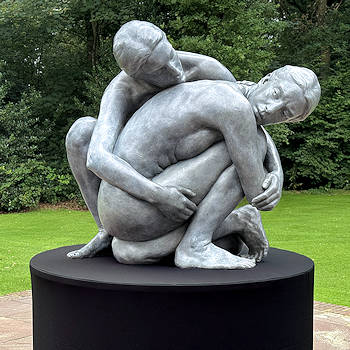
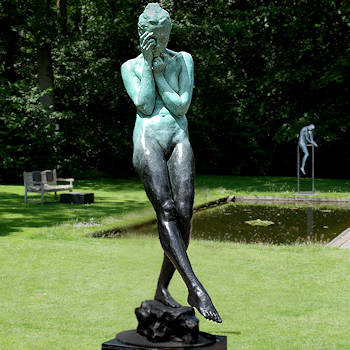
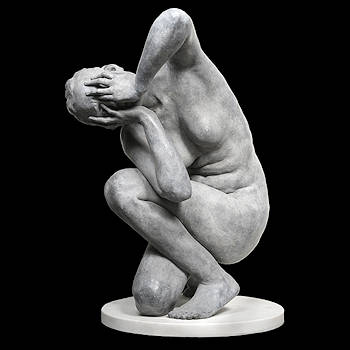
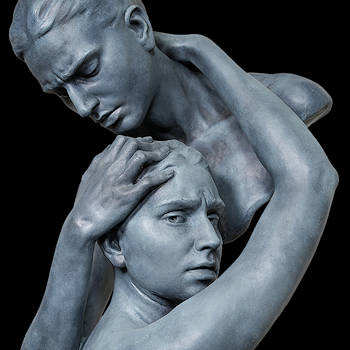
Jana Büttner was trained at the prestigious art academy of Florence in Italy, and it is obvious that she learned classical sculpture to perfection there. But what really leaves you speechless is how she knows how to use her talent and technical skills. Her sculptures are uncompromising and monumental, intense and powerful in their presence – regardless of the size – but at the same time sensitive and tranquil. Two lovingly entwined figures, a balancing woman, or a man carrying another on his back: these are compositions with an exciting, but above all daring and complex attitude to portray. Her eye for detail and the anatomical precision of her human figures immediately command respect. Yet it is the unique and contemporary expression that makes her work so impressive.
Jana Büttner depicts the universal emotions of being human: the inner reflections with which we try to understand and develop ourselves. Feelings such as vulnerability, strength and love are depicted by her in great detail. A posture, a look, or the intimacy of a gesture evoke recognition and invite interaction with us as a spectator. The many curves and details seduce the eye and invite you to look further, after which you are inevitably drawn into the world of experience of her human figures. Like a layered piece of music in several parts, her sculptures resonate and function as mirrors in which our own emotions are reflected.
The emotional and realistic layering of her work makes it particularly intriguing and seems inextricably linked to her personality – perhaps partly shaped by the music city of Salzburg, where Büttner lives and works, alternating with her studio in Florence.



 English ▾